Why Labels Peel Off Plastic Bottles: A Root Cause Analysis
If you’re wondering why labels peel off plastic bottles, the reason is rarely a single obvious flaw. Several small factors usually stack together and break the bond, even though each one alone would have held fine. Before you reprint a run or switch suppliers, work through the five most common root causes in order. The fix for one looks nothing like the fix for another.
1. Low Surface Energy Plastics
Adhesives need a minimum surface energy to wet out and grip a surface. Most plastic bottles sit well below that threshold compared to paper or glass. That’s why a label that holds on one substrate can fail on another.
Polypropylene (PP) and high-density polyethylene (HDPE) cause the most problems. Standard adhesives struggle to form a lasting bond on both, especially without surface treatment first. PET performs better out of the box, but it still sits lower than paper or glass. Any residual mold-release agent or manufacturing oil on the bottle surface makes the problem worse.
The fix isn’t always a different adhesive. Corona treatment on the bottle or the label facestock raises surface energy enough for a standard adhesive to work. It’s often cheaper than switching to a specialty adhesive across an entire run.
2. Wrong Adhesive for the Substrate
Even accounting for surface energy, a mismatched adhesive causes most of the peeling we see. Acrylic adhesives are the default choice for good reason: they hold up across a wide range of plastics and conditions. But “default” isn’t the same as “correct for this job.”
Rubber-based adhesives grip aggressively and fast, which makes them attractive for automated lines. But they degrade under UV exposure and heat, and lose tack over time on low surface energy plastics. Acrylics cost more, but they hold their bond longer and resist temperature swings better. That matters if the bottle sees a hot warehouse, a delivery truck, or direct sun on a shelf.
The adhesive also needs to match the label’s job, not just the bottle’s material. A label that has to survive a fridge and condensation needs a cold-temperature-rated adhesive. A general-purpose adhesive rated for plastic won’t automatically handle that.
3. Application Temperature
Every adhesive has an application temperature range, and applying outside it is one of the most overlooked causes of early peeling. Most adhesives need a specific temperature window to wet out and bond properly. Apply a label in a cold facility, and the adhesive won’t flow the way it’s designed to. That leaves a weak initial bond — one that looks fine on the day but fails within days or weeks.
The bottle’s own temperature matters as much as the room’s. A bottle straight out of cold storage or a chiller develops surface condensation. That moisture sits between the adhesive and the plastic and blocks proper contact. Labels applied to bottles that are too cold, too warm, or damp will often fail before they even leave the line.
4. Curved Surfaces and Label Tension
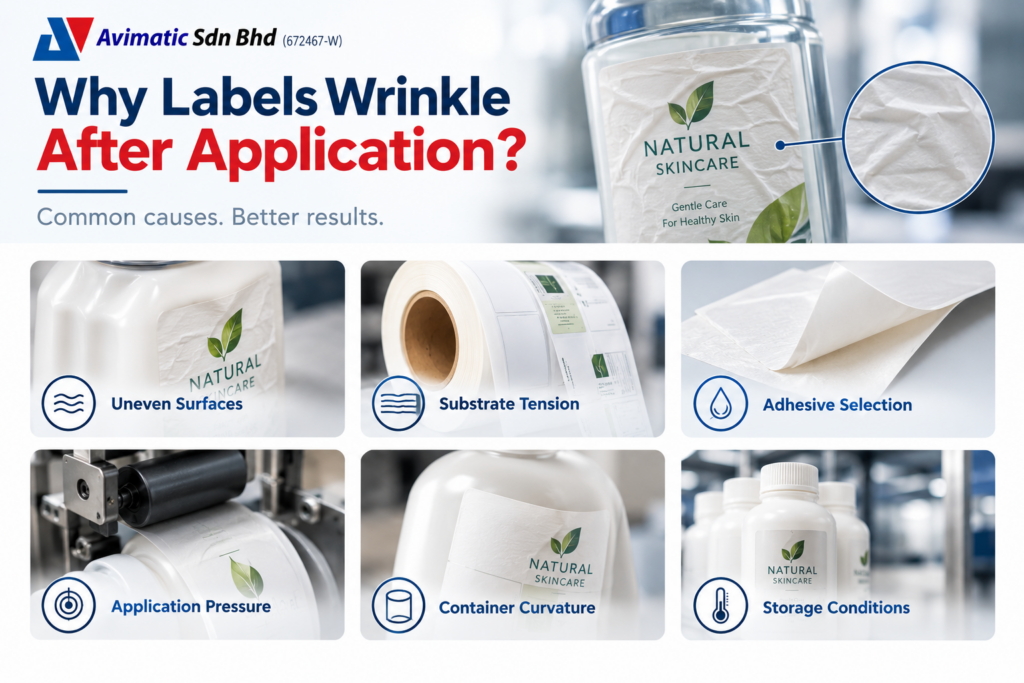
Wrap a label around a curved bottle, and it can lift at the edges even if it bonded perfectly flat on a test sheet. Curvature puts the label under constant mechanical stress. The material wants to flatten back out, and the adhesive has to fight that tension for the life of the product.
Tighter curves and smaller-diameter bottles make this worse, and so does facestock that’s too stiff for the curve. A thinner, more conformable film wraps and holds where a rigid one springs back and lifts at the seam or the edges. Corners on square or angular bottles are a particular weak point, because the label has to bend sharply instead of curving gradually.
Application method compounds this. A label applied off-center, at an angle, or with trapped air starts the tension fight from a worse position. Edges that weren’t pressed down fully are usually the first place peeling shows up.
5. Storage and Handling Conditions
Even a correctly applied label — right adhesive, right temperature, well-matched substrate — can still fail if storage conditions work against it. Humidity is the biggest factor. Adhesives absorb moisture over time in high-humidity environments, and that weakens the bond gradually rather than all at once. That’s why peeling sometimes shows up weeks after application, not immediately.
Stacking and handling add mechanical stress on top of that. Bottles stacked under weight, or handled roughly during transport, put pressure on label edges and seams. That pressure can start a peel that spreads over time. Temperature cycling adds more stress: moving repeatedly between a warm truck and a cold warehouse expands and contracts the bottle and the label material at different rates, stressing the bond with every cycle.
None of this shows up at the point of application — it appears downstream. That’s exactly why teams often misdiagnose it as an adhesive or artwork problem, when the real cause is what happened to the product after it left the line.
Why Labels Peel Off Plastic Bottles: The Five Causes at a Glance
Five things explain most peeling failures: low surface energy plastics, the wrong adhesive for the substrate, application outside the right temperature range, facestock that can’t handle the bottle’s curve, and storage conditions that stress the bond over time. Most failures trace back to more than one cause at once.
Diagnosing Why Labels Peel Off Plastic Bottles
When a label starts peeling, it’s tempting to jump straight to “bad adhesive” and reorder. Check these five things first:
- What plastic is the bottle made of, and has its surface energy been tested or treated?
- Is the adhesive rated for that specific substrate and for the conditions the product will actually see (cold, humid, outdoor)?
- Did you apply the label within the adhesive’s temperature range, on a dry surface?
- Does the facestock conform to the bottle’s curve, or does it fight to spring back flat?
- Where has the product been stored, and for how long, before the peeling appeared?
Most peeling failures trace back to more than one of these at once. A borderline adhesive choice that would have held up in dry storage can fail once you add humidity or temperature cycling on top.
Why Labels Peel Off Plastic Bottles — and How Avimatic Fixes It
We test material and adhesive combinations against the real conditions a label will face, not just a flat lab sample, before we commit to a full production run:
- Substrate and surface energy testing to match the right facestock and adhesive to your specific bottle material
- Adhesive selection based on the product’s actual environment: refrigeration, humidity, UV exposure, or standard shelf conditions
- Pilot batch testing before we scale, the same approach we used in our 100,000-unit label production case study, so an adhesion issue shows up on 500 units, not 100,000
- Conformability testing on your bottle’s actual curve or corner profile, not a generic mockup
If labels are peeling off your bottles and you’re not sure which of these five causes is behind it, send us a sample. We’ll help you diagnose it before you reorder. Get in touch with Avimatic’s team, or reach out directly at ym.moc.citamiva@nehcst.