Label Printing for Chemical Products: What Changes When Your Product Contains Solvents or Oils?
Label printing for chemical products has to survive contact with the product itself, not just the shelf. A label on a bottle of solvent, industrial oil, or agricultural chemical faces a different set of failure modes than a label on a bottle of shampoo: the ink can bleed, the adhesive can lift, and the facestock can degrade from the inside out if any one of five decisions gets made without the contents in mind. Here’s what changes, and what to spec around it.
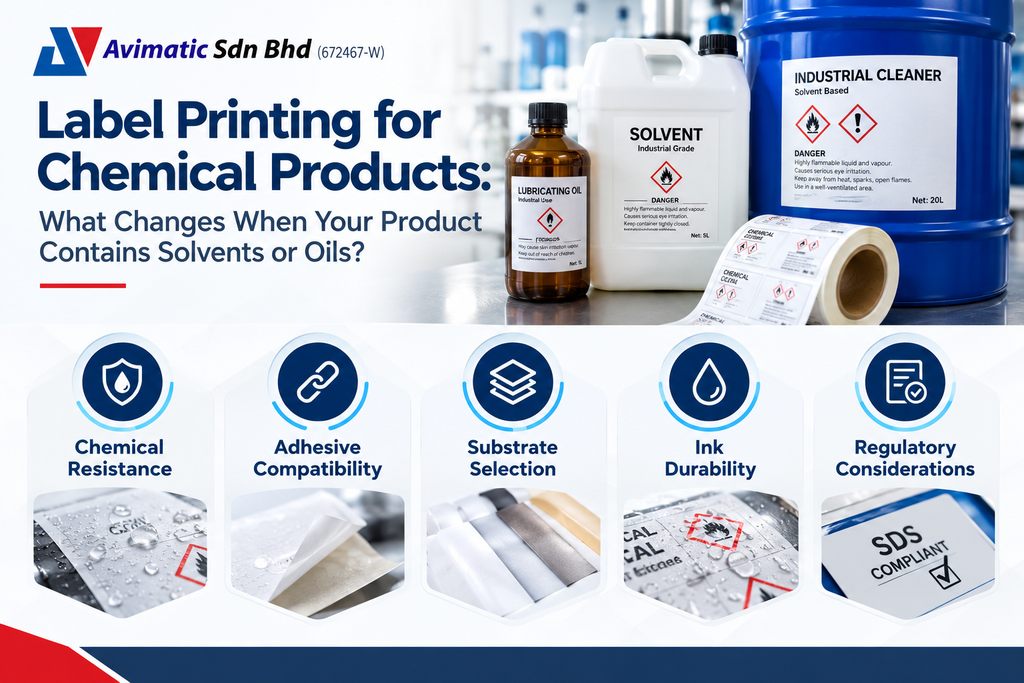
Label Printing for Chemical Products: The Five Things That Change
Compared to labeling a standard consumer product, five decisions shift once solvents or oils are involved:
- Chemical resistance of the facestock and laminate
- Adhesive compatibility with the container surface and the product inside
- Substrate selection suited to the exposure, not just the print quality
- Ink durability against smearing, fading, or chemical attack
- Regulatory considerations specific to hazardous or restricted chemicals
1. Chemical Resistance
Solvents and oils attack labels in ways water never does. A facestock or laminate that shrugs off a splash of water can soften, wrinkle, or delaminate on contact with xylene, mineral spirits, or a fatty industrial oil, and the damage often shows up as clouding or lifting at the edges before the label fails outright.
- Paper facestocks that absorb solvents and disintegrate on contact
- Standard laminates that cloud or delaminate under sustained oil exposure
- Print that looks fine dry but bleeds or smears the moment it’s wiped with solvent
2. Adhesive Compatibility
Oils and solvents don’t just sit on top of a label, they migrate. A standard adhesive can be softened from underneath by oil that seeps through a thin-walled container, or attacked from the outside by solvent residue on a drum or jerry can, and either way the label lifts at the edges first.
- General-purpose acrylic adhesives that soften when oil migrates through the container wall
- Adhesive attacked from the outside by solvent spilled or wiped across the label
- Chemical-resistant acrylic or rubber-based adhesives formulated for oil and solvent contact
3. Substrate Selection
Paper facestocks are out for most chemical products, since they absorb whatever touches them. Synthetic films such as polypropylene, polyester, and vinyl resist absorption and hold up far longer, but they aren’t interchangeable: polyester handles solvents better than polypropylene, and vinyl conforms well to curved drums but softens under some aggressive solvents.
- Polypropylene for general oil resistance at a lower cost
- Polyester for stronger solvent resistance and dimensional stability
- Vinyl for conforming to curved drums and pails, with solvent compatibility checked case by case
Testing Label Printing for Chemical Products Before Full Production
Before committing to a run, test the actual facestock, adhesive, and ink against the actual chemical, not a generic equivalent. Apply sample labels to real containers, expose them to the product through normal handling and a deliberate spill, then inspect at zero, 24, and 72 hours for lifting, clouding, or print smear. A resistance chart is a starting point, not a substitute for testing your specific formulation.
4. Ink Durability
Water-based inks are the first casualty of solvent exposure, smearing or lifting off the facestock on contact. Solvent-based and UV-cured inks bond more aggressively to the substrate and resist smearing, but even a resistant ink benefits from a protective overlaminate when the label will see direct, repeated contact with the product.
- Water-based inks that smear or lift under solvent contact
- Solvent-based and UV-cured inks that bond more aggressively to the facestock
- Protective overlaminate for labels facing direct, repeated chemical contact
5. Regulatory Considerations
Chemical products often fall under GHS (Globally Harmonized System) labeling rules, which set requirements for hazard pictograms, signal words, and precautionary statements that a label must carry legibly for the product’s full shelf life. A label that fades or lifts in the field isn’t just a cosmetic problem at that point, it’s a compliance gap. OSHA’s Hazard Communication Standard pictogram guide outlines the required elements, and Malaysia’s own chemical hazard labeling requirements set similar minimums.
- GHS pictograms and signal words that must stay legible for the product’s shelf life
- Supplier and manufacturer identification requirements on the label itself
- Jurisdiction-specific rules, including Malaysia’s chemical hazard labeling standards and any export market requirements
Label Printing for Chemical Products: The Quick Reference
- Chemical resistance: choose a facestock and laminate rated for the actual solvent or oil, not a generic default
- Adhesive compatibility: test against migration from inside and residue from outside
- Substrate selection: match the film to the exposure, not just the print finish
- Ink durability: pick solvent-based or UV-cured ink, and add overlaminate for direct contact
- Regulatory considerations: keep GHS pictograms and required text legible for the full shelf life
How Avimatic Approaches Label Printing for Chemical Products
We spec labels for chemical products against the product itself, not a generic default:
- Substrate and adhesive matched to the actual chemical exposure, tested the same way we approach adhesive selection in our analysis of why labels peel off plastic bottles
- Full inspection against durability and legibility checks before any order ships, using the same process in our label quality control checklist
- Root-cause isolation when a label fails in the field, the same testing approach behind our guide to why labels wrinkle after application
- Storage and climate exposure factored in from the start, the same approach covered in our guide to how humidity affects self-adhesive labels
Printing labels for a solvent, oil, or other chemical product? Get in touch with Avimatic’s team, or reach out directly at ym.moc.citamiva@nehcst.