Why Labels Wrinkle After Application: Causes, Testing & Solutions
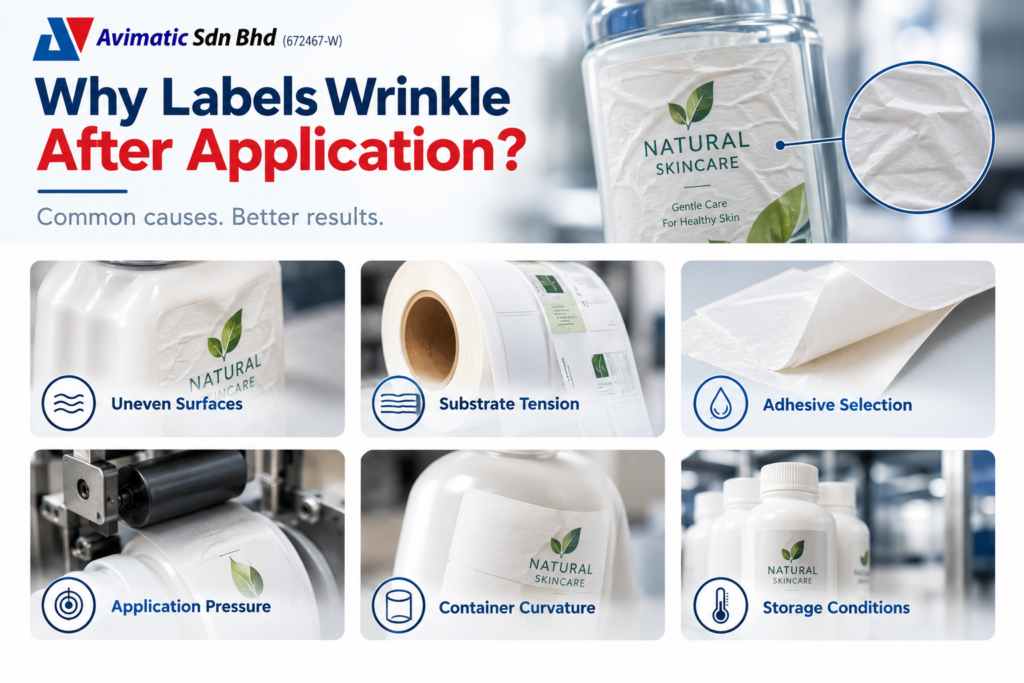
Labels wrinkle after application for one of six reasons, and the label material itself is rarely the real cause. A wrinkle that shows up minutes after the applicator, or days later once the product sits in a warehouse, usually traces back to the surface, the substrate, the adhesive, the pressure at application, the curve of the container, or the conditions the product is stored in afterward. Here’s how to isolate which one is yours before you blame the label.
Why Labels Wrinkle After Application: The Six Root Causes
Most wrinkling complaints fall into one of six categories. Working through them in order, from the surface up, usually isolates the cause within a day:
- Uneven surfaces on the container itself
- Substrate tension carried over from printing or application
- Adhesive selection mismatched to the surface or speed
- Application pressure that’s too light or too heavy
- Container curvature the label wasn’t specced for
- Storage conditions after the label goes on
1. Uneven Surfaces
A label can only lie as flat as the surface underneath it. Ribs, seams, embossed logos, and mold lines on a container create high and low points that a label bridges rather than follows, and the bridge is where the wrinkle forms.
- Embossed or debossed logos and fill lines that sit proud of the surrounding surface
- Seam lines from blow-molded or injection-molded containers, especially where two mold halves meet
- Recessed grip sections or ergonomic curves that a flat label can’t conform to without stretching
2. Substrate Tension
The label material itself carries tension from the print and lamination process, and an applicator adds more as it pulls the web through at speed. If that tension isn’t released evenly before the label contacts the surface, it relaxes after application and pulls the facestock into a wrinkle.
- Facestock stretched during application that shrinks back once released
- Tension settings on the applicator not matched to the label’s actual stiffness
- Overlaminate film applied under uneven tension during production
3. Adhesive Selection
An adhesive that’s too aggressive can seize the label edge before trapped air escapes, and one that’s too soft won’t hold the film taut enough to resist rebound. Peel adhesion tests such as FINAT’s FTM 2 method measure how an adhesive builds tack over time, which is the same property that determines whether a label wrinkles as it sets.
- Adhesive tack too aggressive for the application speed, locking the label down before air escapes
- Adhesive too soft for the surface energy of the container, allowing the film to shift
- Wrong adhesive category entirely, permanent, removable, or freezer-grade, for the storage environment
Testing for Why Labels Wrinkle After Application
Before changing a spec, isolate the cause with a small controlled test: apply ten labels by hand and ten by machine on the same container, then inspect both sets at zero, one, and 24 hours. If only the machine-applied labels wrinkle, the cause is tension or pressure, not adhesive. If both sets wrinkle, look at the surface, the adhesive, or the storage conditions instead.
4. Application Pressure
Too little pressure at the applicator traps air under the label, and trapped air becomes a wrinkle or a bubble the moment the container is handled. Too much pressure stretches the facestock past its recoverable limit, and it wrinkles as it relaxes back.
- Roller or brush pressure not adjusted for the label size or container diameter
- Air pockets trapped at the label’s leading or trailing edge during application
- Dwell time too short for the adhesive to bond before the container moves on
5. Container Curvature
A flat label wrapped around a curved or tapered container has to compress on the inside of the curve and stretch on the outside, and a label that isn’t specced for that curvature will wrinkle exactly where the geometry changes fastest, most often on tapered bottles and shoulders.
- Tapered shoulders and necks where the diameter changes over a short distance
- Compound curves on grip bottles that curve in two directions at once
- Panel labels sized to overlap a curve too large for the facestock’s stretch
6. Storage Conditions
A label that goes on perfectly flat can still wrinkle days later if humidity or temperature swings after application. Moisture absorbed into the facestock or the adhesive expands unevenly, and the label distorts as it dries back out.
- High humidity environments common in Malaysian warehouses without climate control
- Repeated heating and cooling cycles, such as containers moving between a warehouse and a delivery van
- Condensation from cold-chain products sweating once they reach ambient temperature
Why Labels Wrinkle After Application: The Quick Reference
- Uneven surfaces: spec the label around seams and embossing, not across them
- Substrate tension: match tension settings to the label’s actual stiffness
- Adhesive selection: test peel and tack against the real surface, not a generic default
- Application pressure: adjust roller pressure and dwell time to the label size
- Container curvature: size panel labels to the tightest curve on the container
- Storage conditions: choose adhesive and facestock rated for the actual storage environment
How Avimatic Prevents Labels from Wrinkling After Application
We build wrinkle prevention into the spec before printing, not as an afterthought:
- Adhesive selection tested against Malaysia’s heat and humidity, the same approach behind our guide to how humidity affects self-adhesive labels
- Full inspection against adhesion and appearance checks before any order ships, using the same process in our label quality control checklist
- Root-cause testing when a wrinkle does turn up, the same method behind our analysis of why labels peel off plastic bottles
- Roll and tension specs matched to your actual applicator before the first production run, the same specs covered in our guide to designing labels for high-speed automatic application
Getting wrinkles on labels that tested fine in the lab? Get in touch with Avimatic’s team, or reach out directly at ym.moc.citamiva@nehcst.